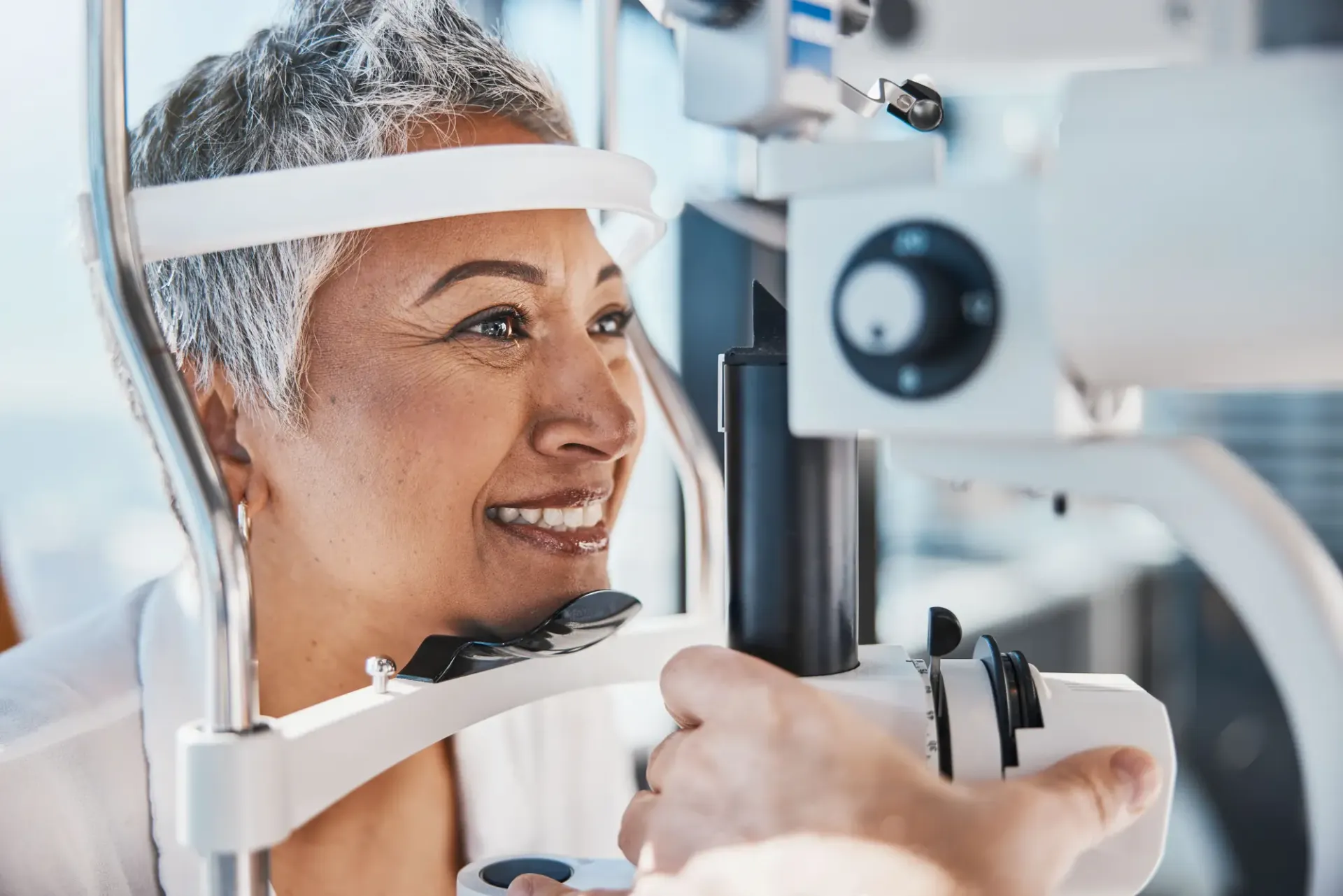
If you’ve been diagnosed with dry age-related macular degeneration (AMD), you may have been told that the most important things you can do are monitor your eyes, look after your general health and watch for changes in your vision.
There is now another option for suitable patients.
At Farmilo Optometrist in Leicester, we offer Valeda Photobiomodulation — a non-invasive light-based treatment specifically developed for people with dry AMD.
Our approach goes beyond simply providing the treatment.
We carefully assess your macula before treatment, measure different aspects of your vision and establish a detailed baseline. We can then repeat those measurements to objectively monitor how your eyes are changing over time.

Age-related macular degeneration affects the macula — the specialised central part of your retina responsible for the detailed vision you use for reading, recognising faces, watching television and driving.
Dry AMD usually develops gradually. In its earlier stages, you may notice very little change in your everyday vision. As the condition progresses, people can experience difficulties with detailed central vision, contrast and other aspects of visual function.
This is why we believe careful monitoring is so important.
Rather than simply asking whether you can still read the same line on an eye chart, we can assess both the structure of your macula and different aspects of how your vision is functioning.
Valeda is a specialist medical device designed to deliver photobiomodulation, often shortened to PBM, to the eye. It uses controlled wavelengths of light as a non-invasive treatment for suitable patients with dry AMD. There are no injections. No surgery. No anaesthetic.
You simply sit comfortably in front of the Valeda system while the treatment is delivered.


Every cell in your body requires energy. Inside your cells are structures called mitochondria, which play an important role in producing that energy.
Photobiomodulation uses specific wavelengths of light and is being studied for its effects on cellular processes associated with mitochondrial function, oxidative stress and inflammation.
These biological processes are relevant to the development and progression of age-related macular degeneration. Valeda delivers controlled light therapy to the eye using a specific treatment protocol. Importantly, this isn’t simply a red-light lamp or an over-the-counter red-light device.
Valeda is a specialist ophthalmic photobiomodulation system designed specifically for treating the eye.
Valeda has been evaluated in clinical studies involving people with dry AMD.
Research has reported improvements in certain measures of visual function in treated patients and has investigated whether treatment may influence aspects of AMD progression.
However, it’s important to have realistic expectations. Valeda does not cure AMD. It cannot guarantee that AMD won’t progress. And it cannot restore vision that has already been permanently lost. Individual responses vary.
Some patients may experience measurable improvements in aspects of their vision, while others may experience little noticeable change. That’s why we believe measuring your individual response is so important. We don’t simply provide a course of treatment and hope that it’s working. We measure.

Before beginning Valeda treatment, we establish a detailed picture of your current macular health and visual function. This gives us something extremely valuable:
Your baseline.
Rather than relying on memory or asking whether your vision “feels different,” we have objective measurements that can be compared with your future results.
A course consists of 9 treatment sessions delivered over approximately three weeks. Treatment is non-invasive and relatively quick. You sit comfortably at the Valeda device while the programmed light treatment is delivered. There are no injections and no anaesthetic required.
After your treatment course, we repeat key measurements from your original assessment. We can then compare your results with the baseline measurements taken before treatment.
We don’t simply hand you a printout.
We’ll sit down with you and explain what your results mean — what has changed, what hasn’t changed and what we recommend next.
Valeda is delivered as repeated treatment courses rather than as a single one-off treatment.
We’ll discuss an appropriate ongoing treatment and monitoring schedule with you based on the treatment protocol, available clinical evidence, your diagnosis and how your individual eyes respond.
AMD can affect different aspects of visual function. That’s why our Valeda assessments don’t rely on a single measurement. We combine structural imaging with functional vision testing to create a more rounded picture of your macular health.

Our Heidelberg SPECTRALIS 4D HD Eye Scan uses advanced Optical Coherence Tomography (OCT) technology to produce highly detailed cross-sectional images of your macula.
This allows us to look beneath the surface of the retina and examine its individual layers and structures. Most importantly, these scans provide a detailed structural record that can be compared over time. We’re not simply asking:
“How does your macula look today?” We’re also asking:
“How has your macula changed?”

Most people are familiar with reading letters from an eye chart. For our AMD assessments, we use ETDRS visual acuity testing to provide a standardised and repeatable measurement of detailed vision. This is particularly useful when comparing visual performance before and after treatment.

Being able to read small black letters against a bright white background doesn’t tell us everything about the quality of your vision.
Contrast sensitivity measures your ability to distinguish objects when the difference between light and dark becomes less obvious.
This can relate more closely to real-world visual situations such as seeing in poor lighting, recognising subtle detail and distinguishing objects from their backgrounds.
Measuring contrast gives us another way of monitoring visual function alongside conventional visual acuity.

We can also assess colour discrimination using the Farnsworth D15 test. This provides another piece of information about visual function rather than relying on one measurement alone.

This is central to the way we approach AMD at Farmilo. We want to understand:
What does your macula look like?
How well is your vision functioning?
How are both changing over time?
By combining our 4D HD Eye Scan with ETDRS visual acuity, contrast sensitivity and colour vision assessment, we can establish a detailed baseline and monitor your results.
Buying a Valeda machine is one thing. Building a proper AMD monitoring service around it is another. At Farmilo, we believe the value comes from combining advanced treatment with careful measurement and professional interpretation. Your treatment journey is therefore built around:
Your treatment begins with a comprehensive baseline assessment. If you decide to proceed with Valeda treatment, we’ll deduct the £150 assessment fee from your treatment cost. There is no obligation to proceed following your assessment.
We’ll explain your recommended treatment schedule and the associated costs before you make a decision.
Both eyes — from £1,200 per 9-session course
One eye — from £1,050 per 9-session course
No. Valeda isn’t suitable for every patient with AMD.
Whether treatment is appropriate depends on factors including the type and stage of your AMD, the health of your retina and your wider eye health.
That’s why we don’t recommend Valeda simply because someone has been told they have AMD. We assess your eyes first. If we believe you’re suitable, we’ll explain why, what treatment involves and what you can realistically expect.
If we don’t believe Valeda is appropriate for your eyes, we’ll tell you.
No. Valeda should not be regarded as a cure for AMD.
The aim is to use photobiomodulation as part of the management of suitable patients with dry AMD. Individual results vary and continued monitoring remains important.
Valeda treatment is non-invasive and doesn’t involve injections or surgery. You sit comfortably at the device while the programmed light treatment is delivered.
One treatment course consists of 9 sessions delivered over approximately three weeks. Valeda treatment is generally delivered in repeated courses rather than as a single one-off course. We’ll discuss the recommended ongoing schedule during your assessment.
Some clinical studies have reported improvements in certain measures of visual function following photobiomodulation treatment. However, this doesn’t mean every patient will notice an improvement. Results vary, which is why we take detailed measurements before and after treatment.
Because not everybody with AMD is necessarily suitable for Valeda.
Your assessment allows us to examine your macula, understand your current vision and establish baseline measurements before deciding whether treatment is appropriate.
We’ll tell you.
The purpose of the assessment is to determine what’s appropriate for your eyes — not simply to sell you a course of treatment.
We’ll explain our findings and discuss appropriate next steps.
If you’ve been diagnosed with dry age-related macular degeneration and would like to understand whether Valeda could be appropriate for you, the first step is a comprehensive AMD and Valeda assessment.
At Farmilo Optometrist, we’ll assess your vision, examine your macula using our Heidelberg SPECTRALIS 4D HD Eye Scan, establish detailed baseline measurements and explain your options.

Helping You Make More of the Vision You Have
Assessment fee deducted from your treatment cost if you proceed.
Farmilo Optometrist — Leicester